
I think I found a planet nobody knew existed.
It's been hiding in NASA telescope data for seven years.
At the end of this thread, you can fly to it yourself.


Pavel Rabtsevich
@p_rabtsevich
NASA's TESS (@NASA_TESS) telescope watches thousands of stars and records how bright they are. Last month I was going through its data from late 2025, and one star kept getting a little dimmer every 3 days, for about two hours each time.
12:02 PM UTC · Oct 7, 2026 · 70.4K Views
31146639

Pavel Rabtsevich
@p_rabtsevich
That's what you'd see if a planet were passing in front of the star and blocking a bit of its light.
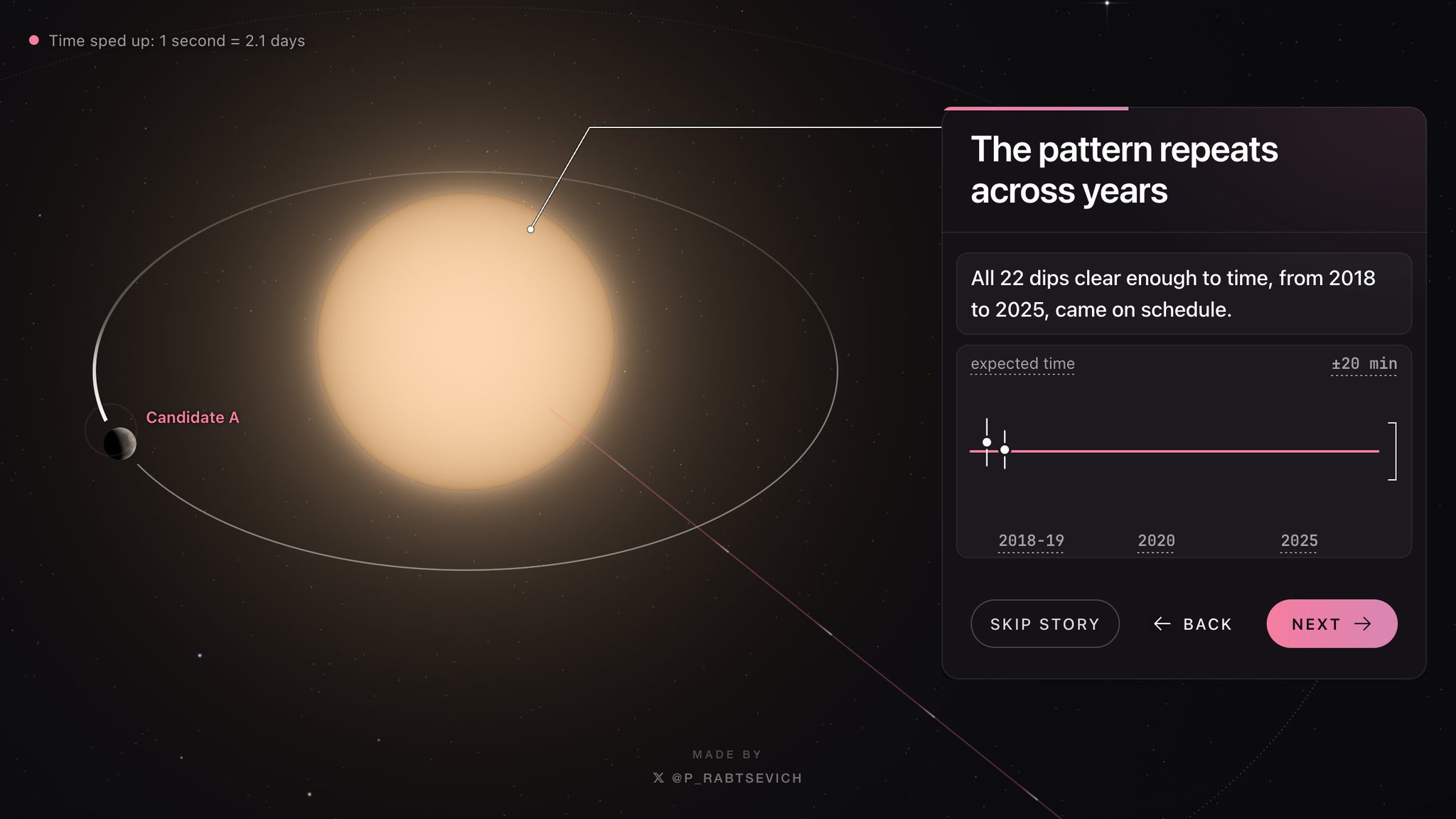
So I went back to older data on the same star, from 2020 and 2018. It was doing the same thing there. I timed 22 of these dimmings, and every one came on schedule.
So I went back to older data on the same star, from 2020 and 2018. It was doing the same thing there. I timed 22 of these dimmings, and every one came on schedule.
12:02 PM UTC · Oct 7, 2026 · 56.1K Views
2634516

Pavel Rabtsevich
@p_rabtsevich
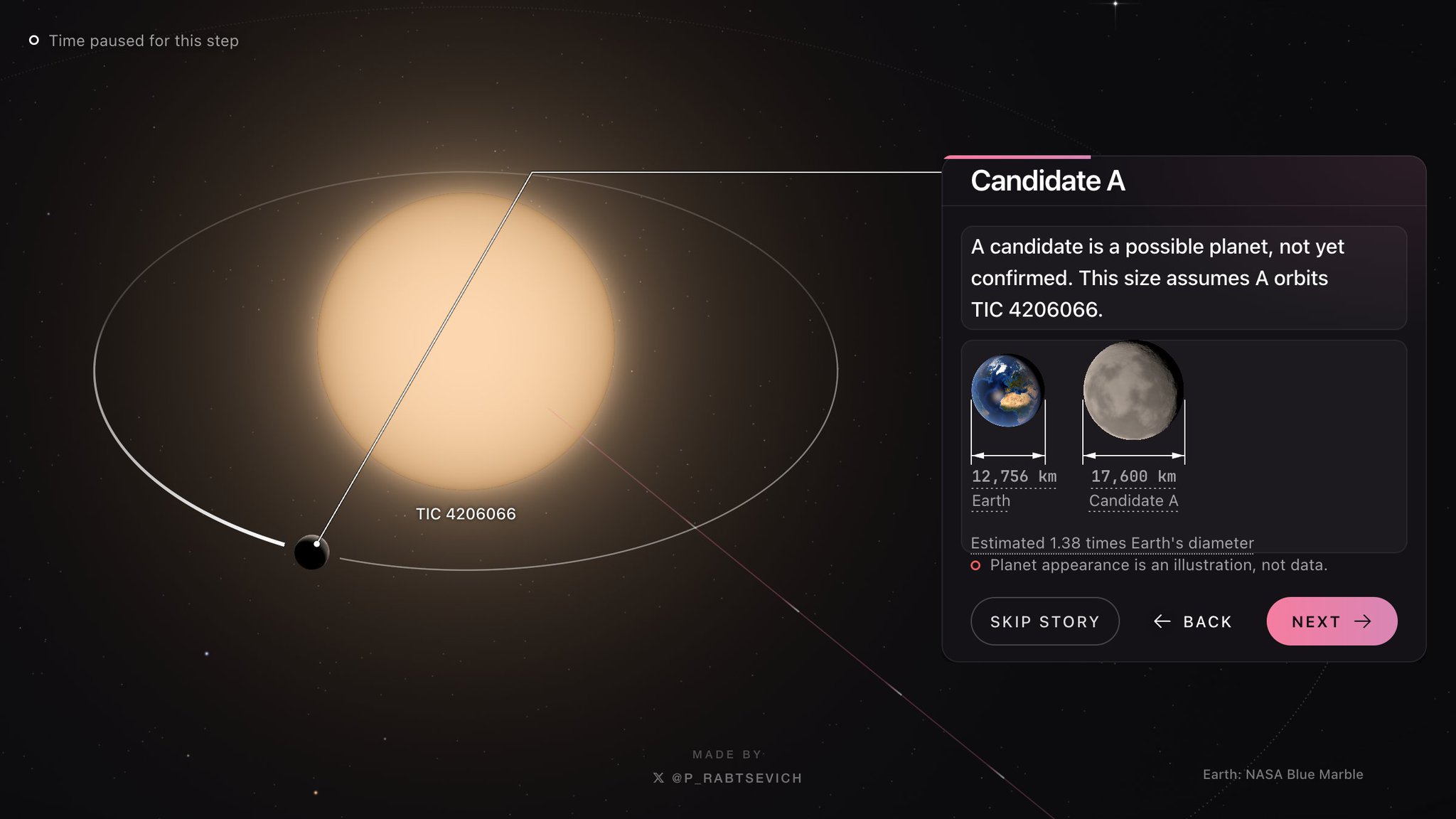
The first planet is about 1.4 times the size of Earth. Planets that size are usually rocky.
A year there lasts just over 3 days. It gets about 70 times more starlight than Earth, so it's roughly 530 °C there (about 1,000 °F), hot enough to melt lead.
A year there lasts just over 3 days. It gets about 70 times more starlight than Earth, so it's roughly 530 °C there (about 1,000 °F), hot enough to melt lead.
12:02 PM UTC · Oct 7, 2026 · 48.7K Views
1730810

Pavel Rabtsevich
@p_rabtsevich
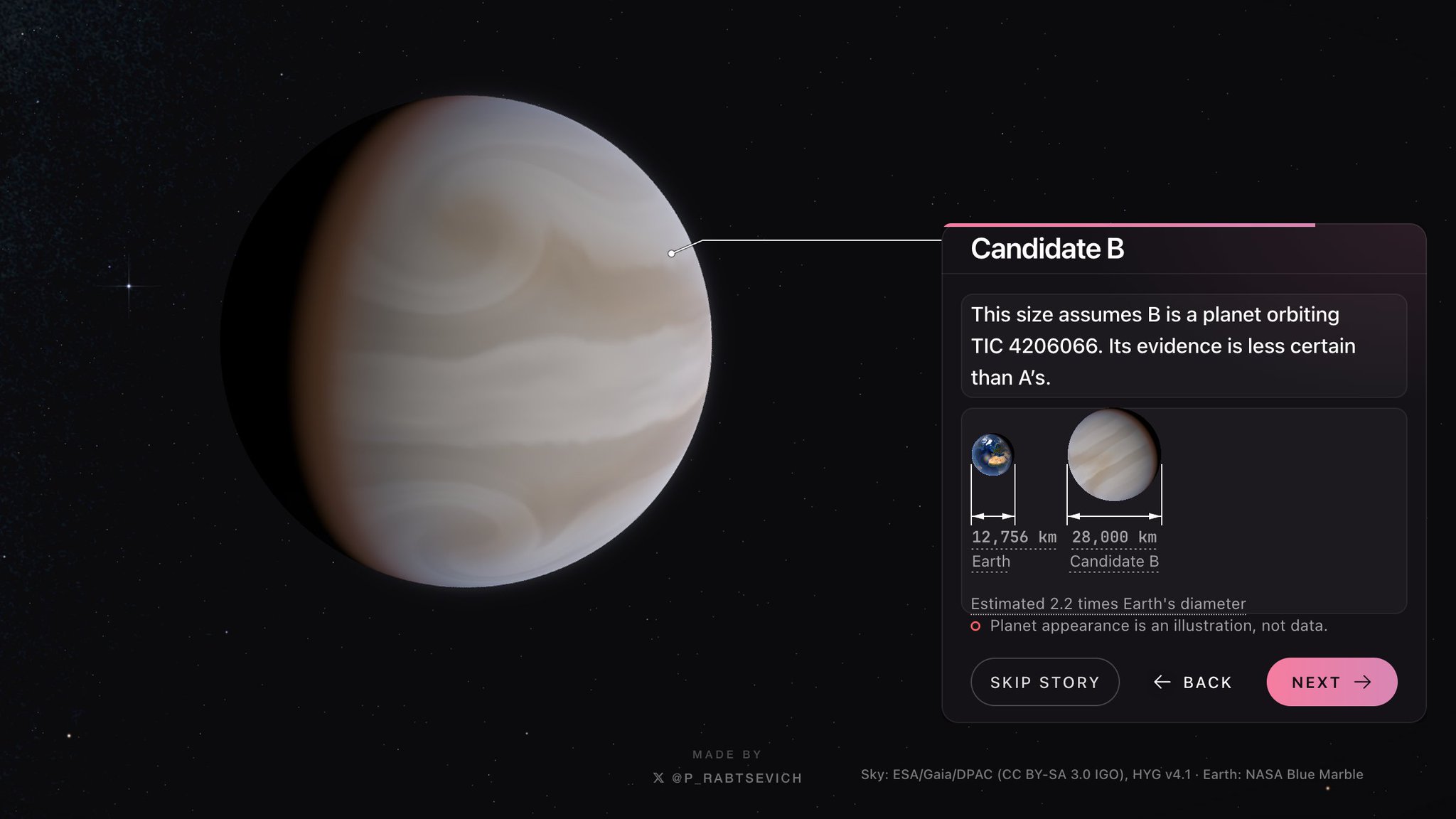
There might be a second planet, a bit over twice Earth's size. It goes around every 11 days and it's cooler, around 260 °C (500 °F).
I'm less sure about this one. November's data is its next test.
I'm less sure about this one. November's data is its next test.
12:02 PM UTC · Oct 7, 2026 · 44.7K Views
3626912

Pavel Rabtsevich
@p_rabtsevich
Two weeks of trying to prove myself wrong: 74 separate analyses and over 1,000 scripts, built with Claude Code (@claudeai) and Codex (@OpenAIDevs).
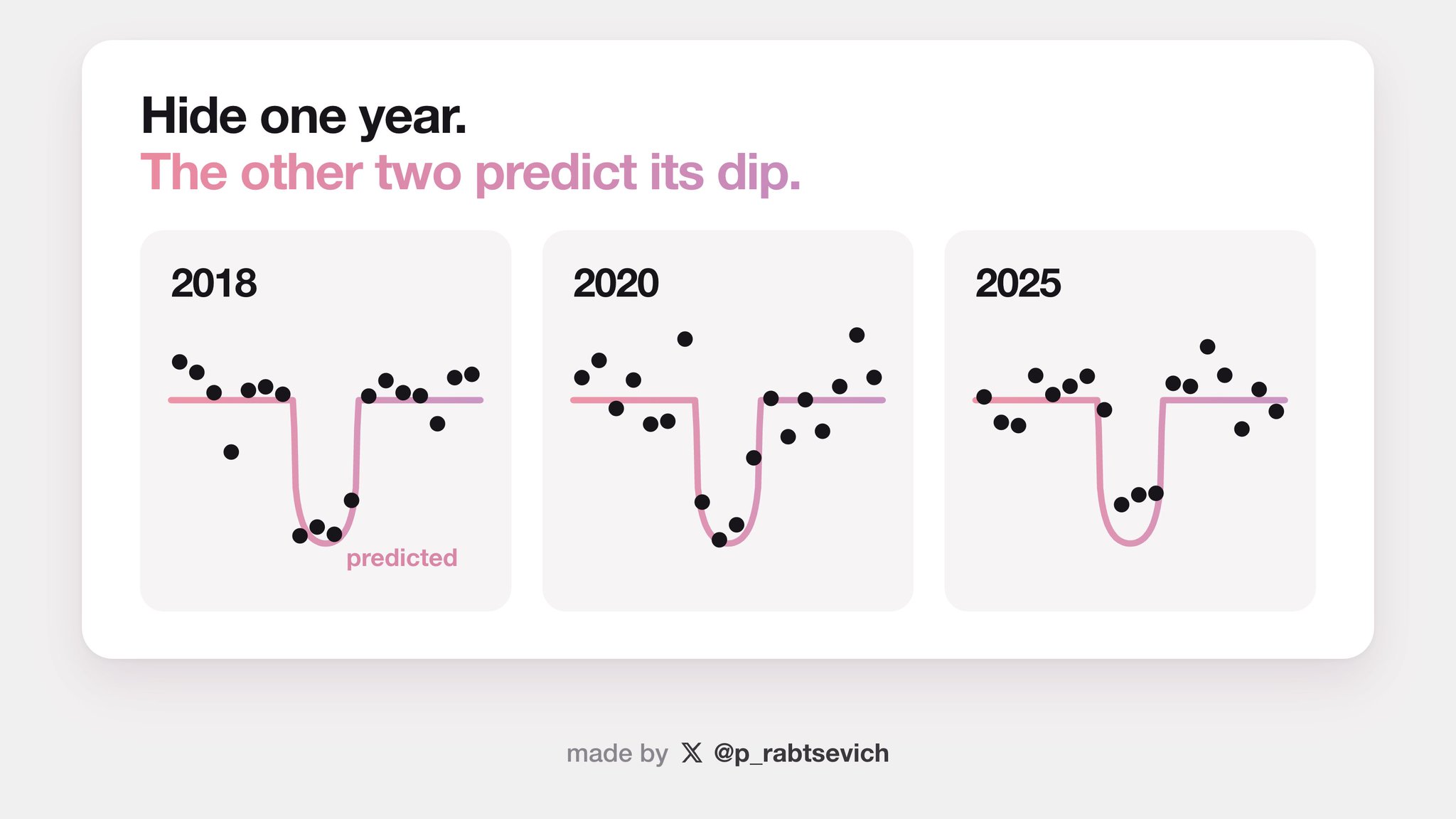
My favorite: I hid each year of data and let the other two predict when the star would dim. Right 3 times out of 3.
My favorite: I hid each year of data and let the other two predict when the star would dim. Right 3 times out of 3.
12:02 PM UTC · Oct 7, 2026 · 41.7K Views
3638725

Pavel Rabtsevich
@p_rabtsevich
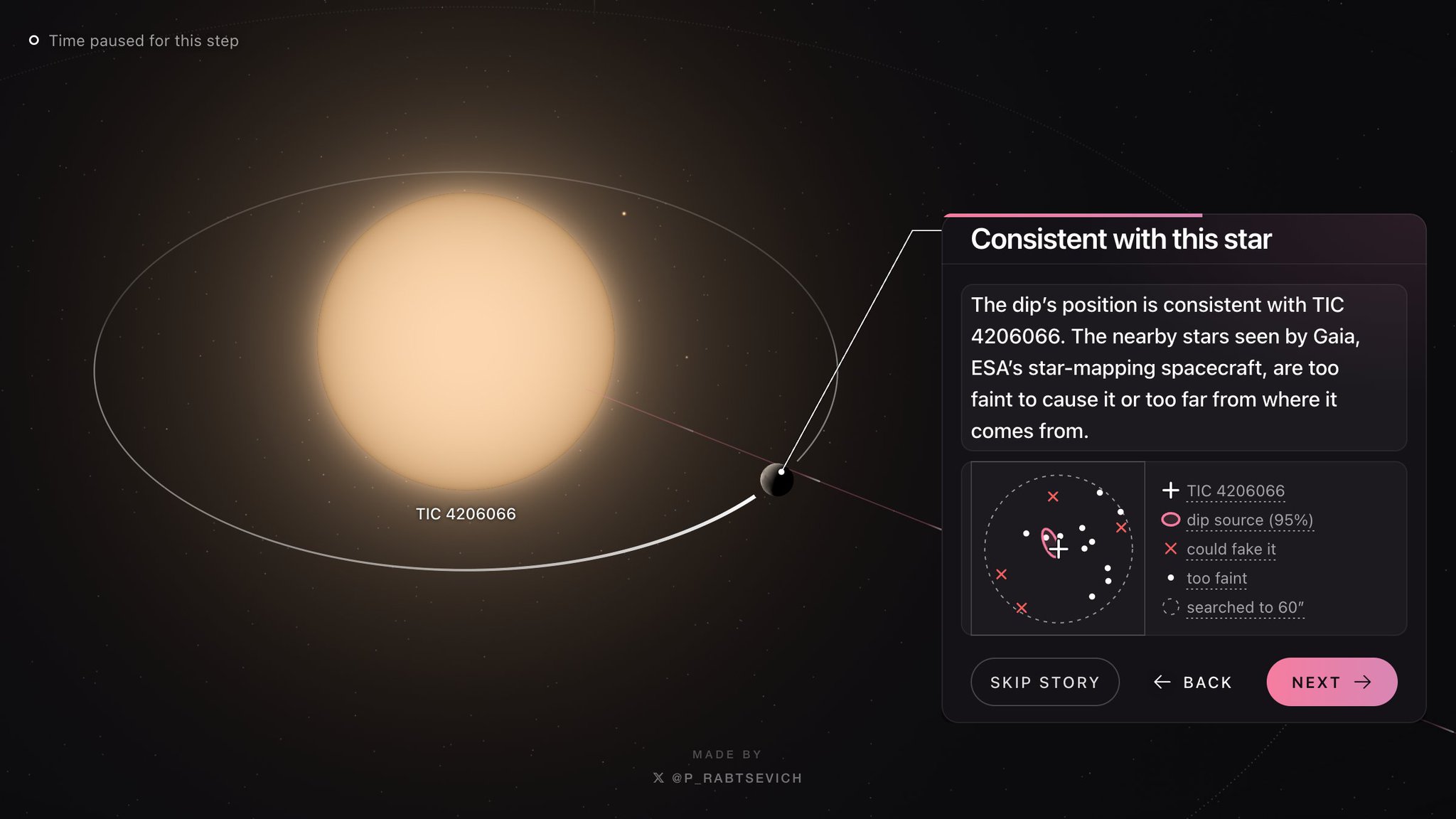
Every known nearby star that could fake this dimming is ruled out.
Then I rebuilt the whole analysis from zero, with new code and freshly downloaded data. 364 numbers, recomputed one by one. The main result held.
Then I rebuilt the whole analysis from zero, with new code and freshly downloaded data. 364 numbers, recomputed one by one. The main result held.
12:02 PM UTC · Oct 7, 2026 · 38.8K Views
3425110

Pavel Rabtsevich
@p_rabtsevich
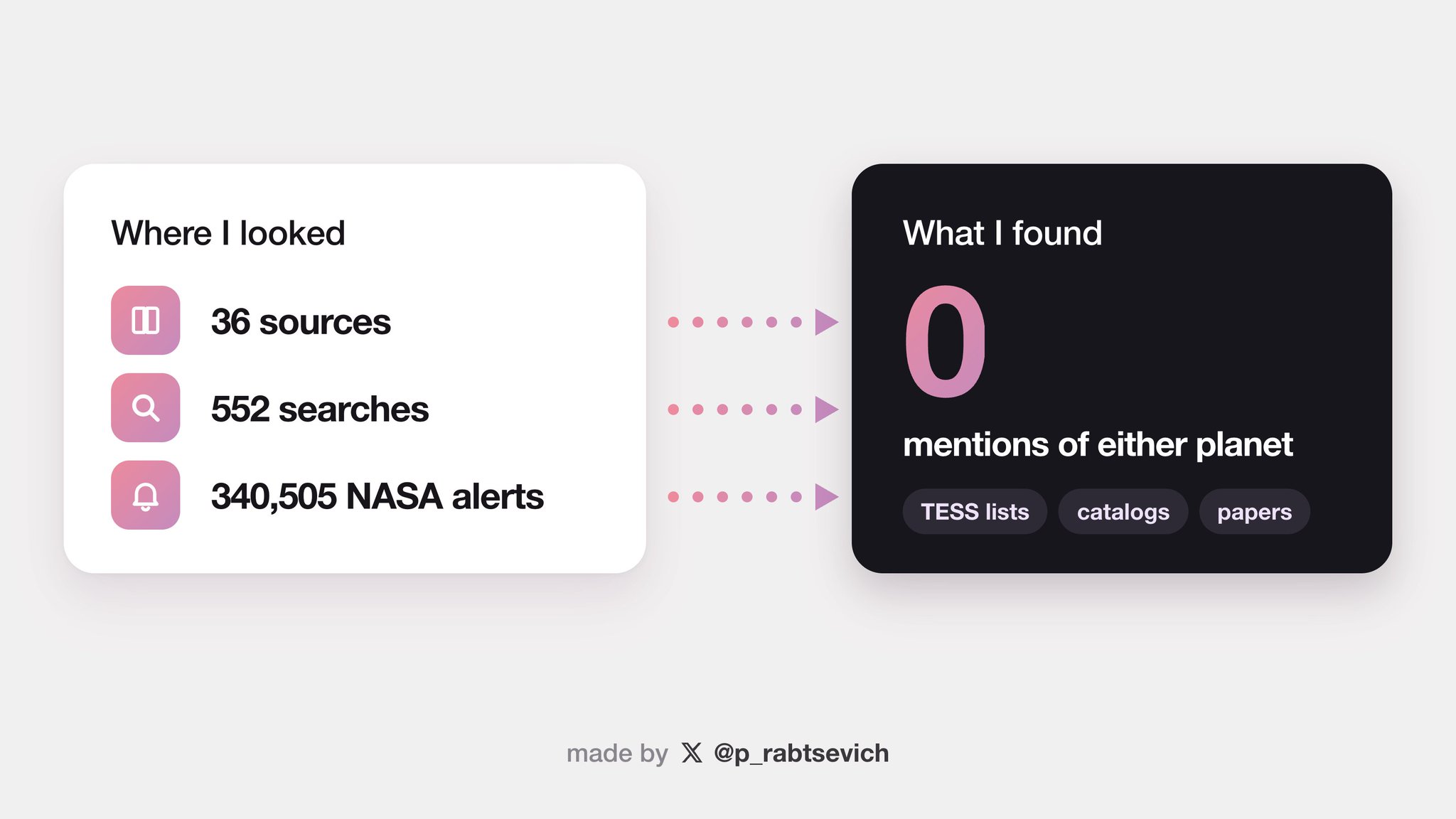
Then I checked whether anyone had found it before me. I went through 30+ sources, ran 550+ searches and checked 340k+ automatic alerts from NASA's own planet-hunting software.
Neither planet shows up anywhere.
Neither planet shows up anywhere.
12:02 PM UTC · Oct 7, 2026 · 36.3K Views
1526411

Pavel Rabtsevich
@p_rabtsevich
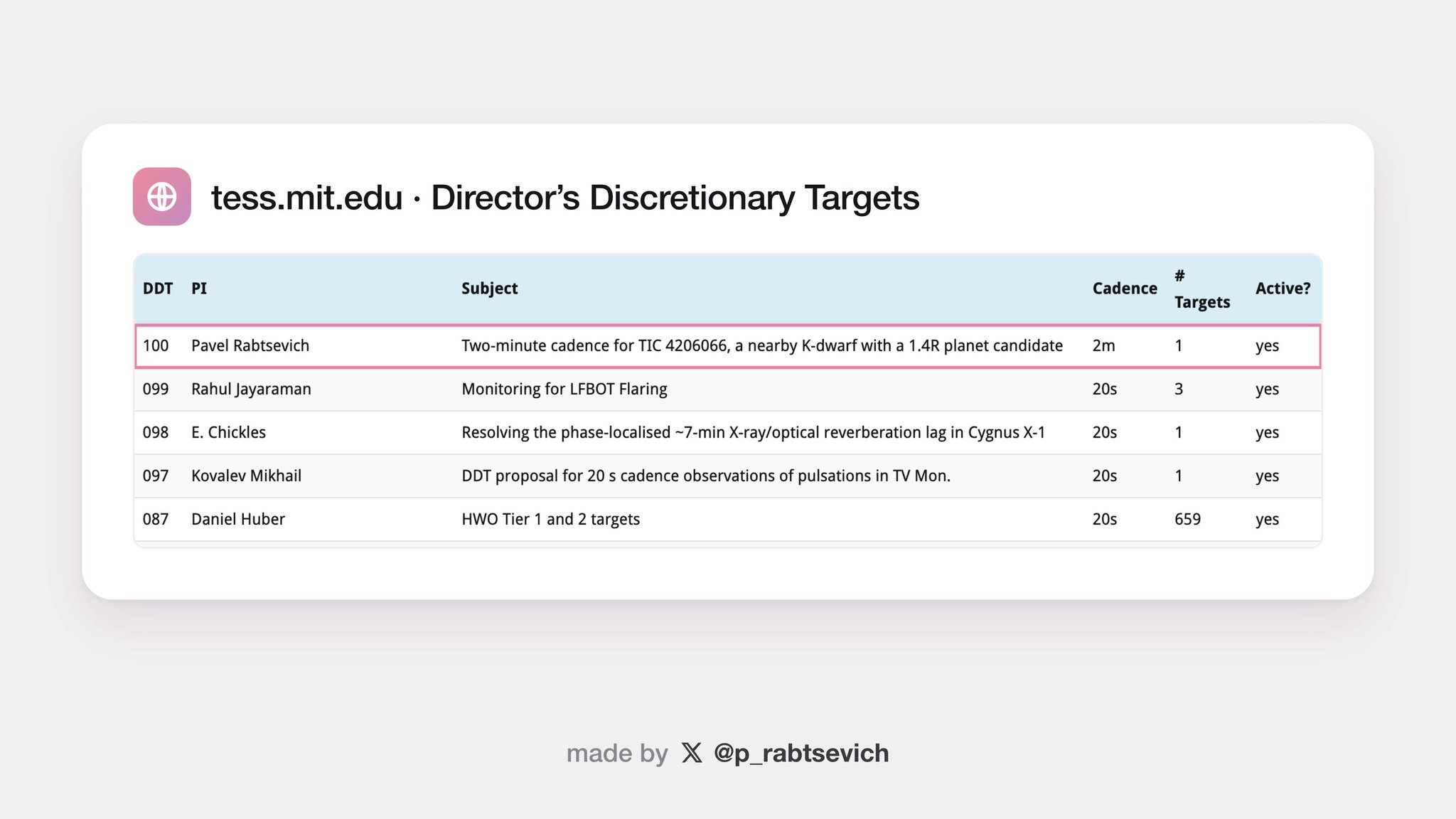
So I wrote a formal observing proposal to the TESS mission, and it was approved. When the telescope comes back to this part of the sky in November, it will record this star every 2 minutes.
It's listed as program #100: tess.mit.edu/science/ddt/
It's listed as program #100: tess.mit.edu/science/ddt/
12:02 PM UTC · Oct 7, 2026 · 34.5K Views
41451430

Pavel Rabtsevich
@p_rabtsevich
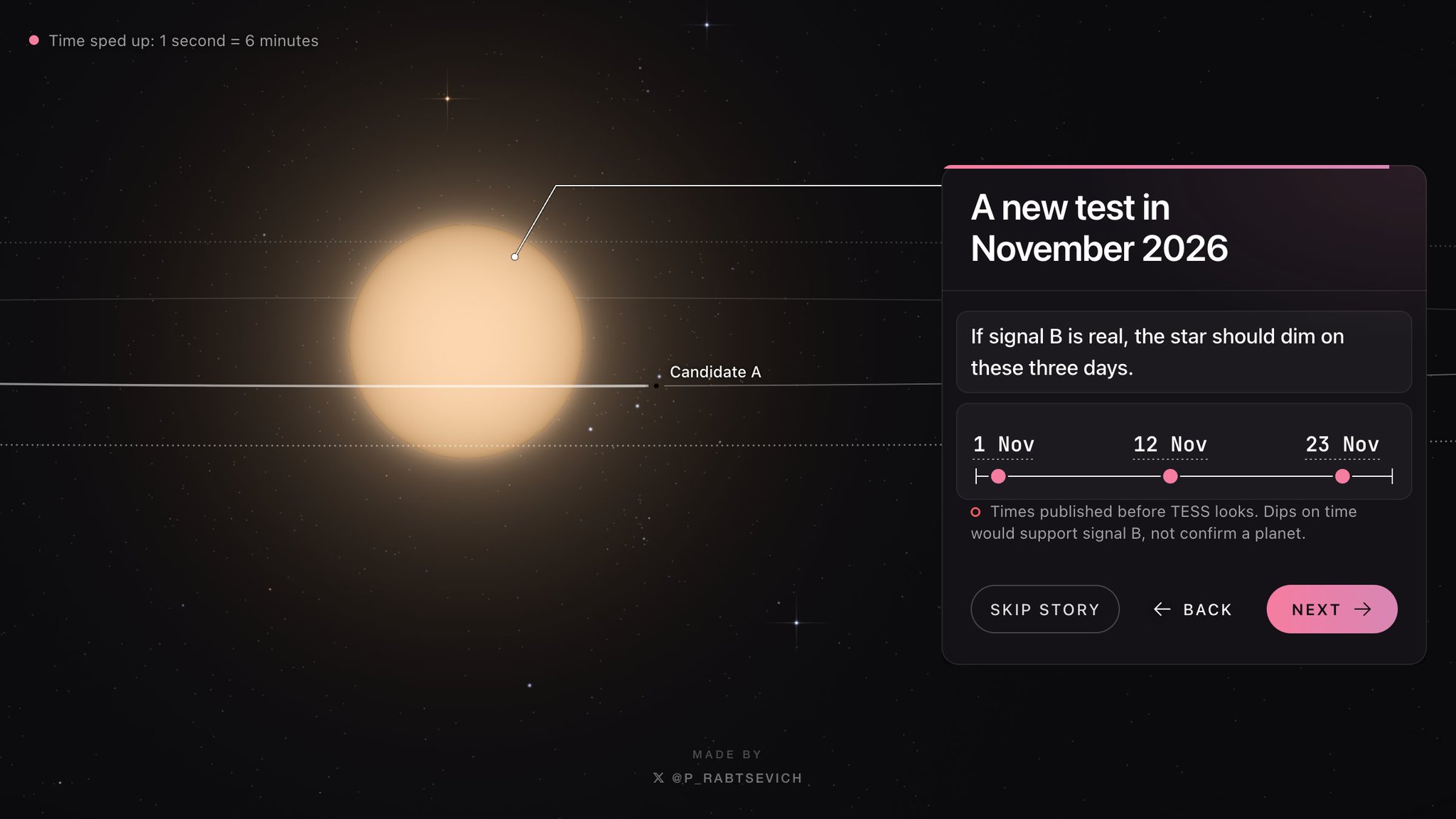
On Oct 6 I published the exact times the star should dim in November, before the telescope takes a single picture: doi.org/10.5281/zenodo…
When the data comes out, anyone can check my times against it.
When the data comes out, anyone can check my times against it.
12:02 PM UTC · Oct 7, 2026 · 33.4K Views
4332115

Pavel Rabtsevich
@p_rabtsevich
None of this confirms it yet. If the star dims on time in November, this gets a lot more serious. If it doesn't, I'll post that too.
The star is TIC 4206066.
Fly around it in 3D: tic4206066.pages.dev
Write-up: doi.org/10.5281/zenodo…
Data and code: doi.org/10.5281/zenodo…
The star is TIC 4206066.
Fly around it in 3D: tic4206066.pages.dev
Write-up: doi.org/10.5281/zenodo…
Data and code: doi.org/10.5281/zenodo…
tic4206066.pages.dev
TIC 4206066 | Two possible planets
Explore a 3D model of TIC 4206066 and two possible planets suggested by TESS observations. See the evidence and what remains uncertain.
12:02 PM UTC · Oct 7, 2026 · 32.7K Views
1716606129