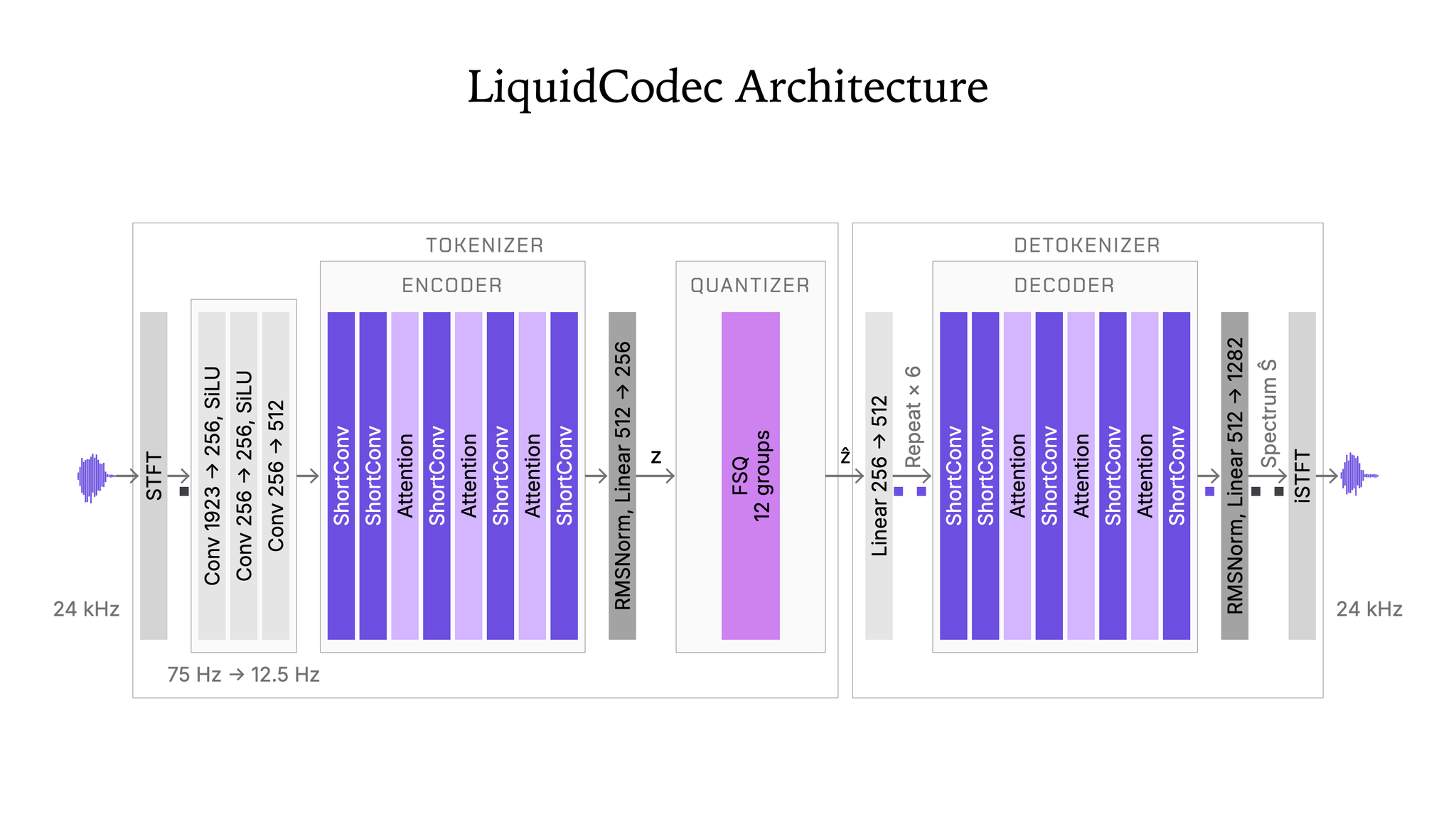
Introducing 𝙻𝚒𝚚𝚞𝚒𝚍𝙲𝚘𝚍𝚎𝚌, our ~74M-parameter streaming audio codec powering LFM3-Audio-2B and LFM3-Omni-2B.
An audio codec turns speech into tokens a language model can predict, then converts those tokens back into audio. We built ours around two requirements: tokens that are easy to predict and fast conversion back into speech.
On a single CPU thread on an Apple M4 Max, LiquidCodec runs at approximately:
> 361× real time for encoding
> 87× real time for decoding
Both measurements use FP32 precision.
1/ 🧵


Liquid AI
@liquidai
In LFM2-Audio-1.5B, we used Mimi, a third-party codec, to turn speech into tokens and back into audio.
For LFM2.5-Audio-1.5B, we replaced only the detokenizer, the part that converts tokens back into speech. That made detokenization 8× faster, but keeping Mimi’s tokenizer meant we were still limited by its token quality and architectural choices.
For LFM3, we built and trained our own codec, LiquidCodec, to control both the quality of the audio tokens and how easily our models could predict them.
One key change was how we turn audio features into tokens. Mimi’s residual vector quantization (RVQ) creates strong dependencies between codebooks. LiquidCodec uses grouped finite scalar quantization (GFSQ), which quantizes groups of features independently. This reduces those dependencies and allows speech models to predict multiple tokens in parallel over several refinement steps.
2/
For LFM2.5-Audio-1.5B, we replaced only the detokenizer, the part that converts tokens back into speech. That made detokenization 8× faster, but keeping Mimi’s tokenizer meant we were still limited by its token quality and architectural choices.
For LFM3, we built and trained our own codec, LiquidCodec, to control both the quality of the audio tokens and how easily our models could predict them.
One key change was how we turn audio features into tokens. Mimi’s residual vector quantization (RVQ) creates strong dependencies between codebooks. LiquidCodec uses grouped finite scalar quantization (GFSQ), which quantizes groups of features independently. This reduces those dependencies and allows speech models to predict multiple tokens in parallel over several refinement steps.
2/
6:31 PM UTC · Nov 12, 2026 · 3.6K Views
10468

Liquid AI
@liquidai
We trained LiquidCodec in two stages.
First, we pretrained it on 264,000 hours across 107 languages. Waveform and spectral losses taught it to reconstruct the input without adversarial training.
The reconstructions still had some metallic artifacts. To improve perceptual quality, we fine-tuned on 55,000 hours of cleaner speech, natively sampled at 24 kHz or above.
This second stage added adversarial critics that examine waveform patterns, spectral detail, and speech features. The artifacts gradually disappeared as the model learned to reconstruct more natural speech.
3/
First, we pretrained it on 264,000 hours across 107 languages. Waveform and spectral losses taught it to reconstruct the input without adversarial training.
The reconstructions still had some metallic artifacts. To improve perceptual quality, we fine-tuned on 55,000 hours of cleaner speech, natively sampled at 24 kHz or above.
This second stage added adversarial critics that examine waveform patterns, spectral detail, and speech features. The artifacts gradually disappeared as the model learned to reconstruct more natural speech.
3/
6:31 PM UTC · Nov 12, 2026 · 2.5K Views
11324

Liquid AI
@liquidai
Reconstruction quality tells us how well a codec preserves a recording. We also wanted to know how well a speech model could learn to predict its tokens.
We trained text-to-speech (TTS) models to compare LiquidCodec with X-Codec 2, NanoCodec, and Mimi. Each used the same LFM3-1.7B backbone, training setup, compute budget, and 101,000 hours of speech across six languages.
Across eight test sets, LiquidCodec achieved:
> Best reconstruction ViSQOL and lowest mel distance
> Highest TTS naturalness score (UTMOSv2)
> Best TTS intelligibility (WER/CER) on four of eight test sets
TTS results aggregate three generation trials. Repeating the experiment with a Qwen3-1.7B backbone gave consistent results.
4/
We trained text-to-speech (TTS) models to compare LiquidCodec with X-Codec 2, NanoCodec, and Mimi. Each used the same LFM3-1.7B backbone, training setup, compute budget, and 101,000 hours of speech across six languages.
Across eight test sets, LiquidCodec achieved:
> Best reconstruction ViSQOL and lowest mel distance
> Highest TTS naturalness score (UTMOSv2)
> Best TTS intelligibility (WER/CER) on four of eight test sets
TTS results aggregate three generation trials. Repeating the experiment with a Qwen3-1.7B backbone gave consistent results.
4/
6:31 PM UTC · Nov 12, 2026 · 2.1K Views
10264

Liquid AI
@liquidai
LiquidCodec’s speed comes from its architecture and how it reconstructs audio.
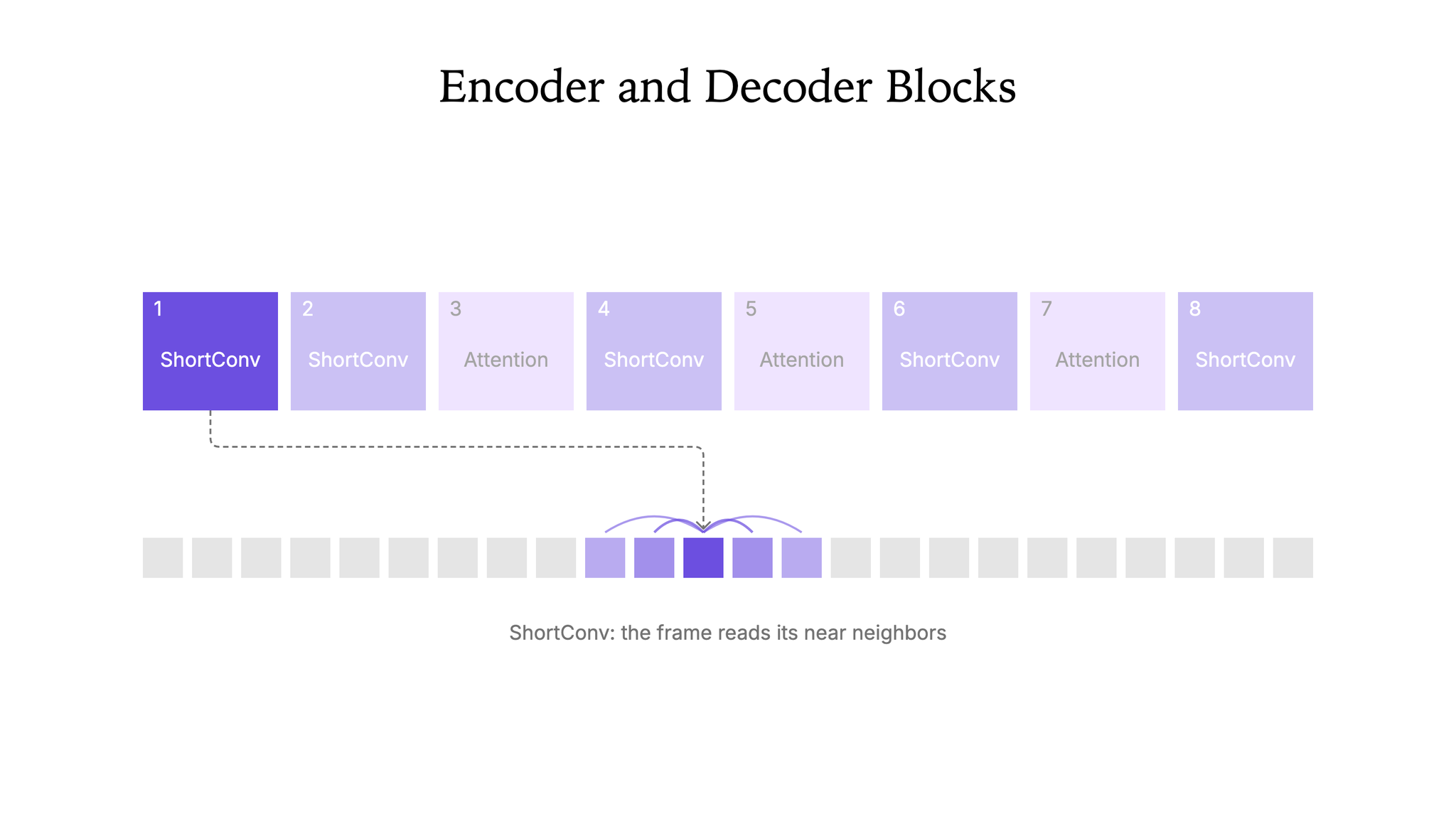
The encoder and decoder use the same LFM3 block architecture, and the encoder is fully causal for streaming. The decoder predicts spectral coefficients directly, avoiding the progressive upsampling with learned transposed convolutions used by some other codecs.
We also fine-tuned the decoder with quantization-aware training for on-device inference.
Q4_0 reduces the decoder footprint by 3.5× with minimal impact on reconstruction quality. It retains its ViSQOL and mel-distance lead over the external codecs in our comparison.
5/
The encoder and decoder use the same LFM3 block architecture, and the encoder is fully causal for streaming. The decoder predicts spectral coefficients directly, avoiding the progressive upsampling with learned transposed convolutions used by some other codecs.
We also fine-tuned the decoder with quantization-aware training for on-device inference.
Q4_0 reduces the decoder footprint by 3.5× with minimal impact on reconstruction quality. It retains its ViSQOL and mel-distance lead over the external codecs in our comparison.
5/
6:31 PM UTC · Nov 12, 2026 · 2.5K Views
10272

Liquid AI
@liquidai
High-quality voice interaction on a device needs fast audio processing and a small memory footprint.
Building LiquidCodec in-house lets us improve the speech representation alongside the models that learn from it.
LiquidCodec is available on Hugging Face. See the model card for installation and loading instructions.
Explore the architecture, training recipe, and results.
> Blog: liquid.ai/blog/liquidcodec
> Hugging Face: huggingface.co/LiquidAI/Liquid-Codec
Building LiquidCodec in-house lets us improve the speech representation alongside the models that learn from it.
LiquidCodec is available on Hugging Face. See the model card for installation and loading instructions.
Explore the architecture, training recipe, and results.
> Blog: liquid.ai/blog/liquidcodec
> Hugging Face: huggingface.co/LiquidAI/Liquid-Codec
6:31 PM UTC · Nov 12, 2026 · 2.9K Views
386423