Introducing SID-2, a new search model built on compute-scaling swarms.
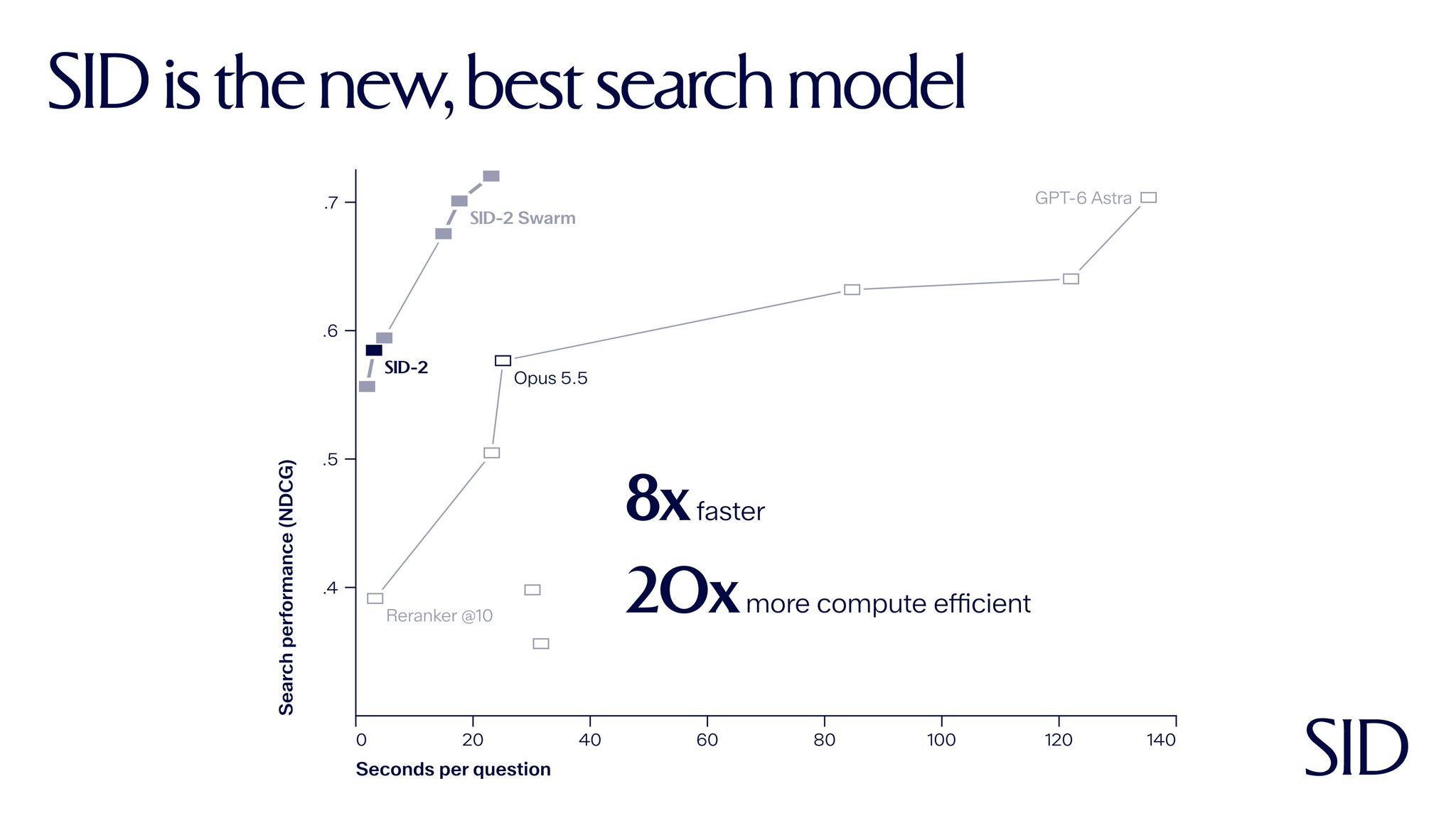
Our swarms find better results than Opus and Astra, while being 8x faster and 20x lower cost.
By 2030, AI will write an internet's worth of text every 24 hours. Current search pipelines were built on hand-designed rules, adding more won't scale to meet this incoming volume of data.
SID-2 is available on our API today. Try it on your most demanding searches.


Max Rumpf
@maxrumpf
The total volume of text in the world dwarfs the internet. What AI has written this year exceeds both.
The web's growth rate has fallen to the lowest level in a decade (+8%), while AI output is growing 9-15x annually.
The most valuable information AI creates won't be shared with everyone, but will feed an exploding corpus of private data.
Companies and individuals are now sitting on amounts of text previously reserved for governments and a handful of enterprises.
The web's growth rate has fallen to the lowest level in a decade (+8%), while AI output is growing 9-15x annually.
The most valuable information AI creates won't be shared with everyone, but will feed an exploding corpus of private data.
Companies and individuals are now sitting on amounts of text previously reserved for governments and a handful of enterprises.
6:27 PM UTC · Nov 17, 2026 · 17.2K Views
138732

Max Rumpf
@maxrumpf
Current search methods allocate a fixed amount of compute to each query and return a fixed number of results, regardless of corpus size and question difficulty. Performance therefore degrades steeply as datasets grow.
Rerankers can help eliminate irrelevant results at the end, but they cannot go back and find additional documents that were missed in initial queries.
If we want to make sense of the incoming volume of data, we need fundamentally more scalable techniques for search.
Rerankers can help eliminate irrelevant results at the end, but they cannot go back and find additional documents that were missed in initial queries.
If we want to make sense of the incoming volume of data, we need fundamentally more scalable techniques for search.
6:43 PM UTC · Nov 17, 2026 · 12.2K Views
225020

Max Rumpf
@maxrumpf
Scaling parameter count has been the primary driver of recent AI progress. But unlike in math and coding, search only gets modest gains from increasing model size.
SID-2 takes the opposite approach. We observe:
1. Search is highly divisible
2. Search has a high proposer/verifier gap: It is easy to determine whether a document answers a question.
To exploit these properties, we began by training a small and fast search agent and scaled it up in a coordinated swarm.
We find that the returns to swarm scaling are greater than parameter scaling for search.
SID-2 takes the opposite approach. We observe:
1. Search is highly divisible
2. Search has a high proposer/verifier gap: It is easy to determine whether a document answers a question.
To exploit these properties, we began by training a small and fast search agent and scaled it up in a coordinated swarm.
We find that the returns to swarm scaling are greater than parameter scaling for search.
6:53 PM UTC · Nov 17, 2026 · 9.4K Views
104213

Max Rumpf
@maxrumpf
SID-2 and SID-2 swarm are available today on sid.ai.
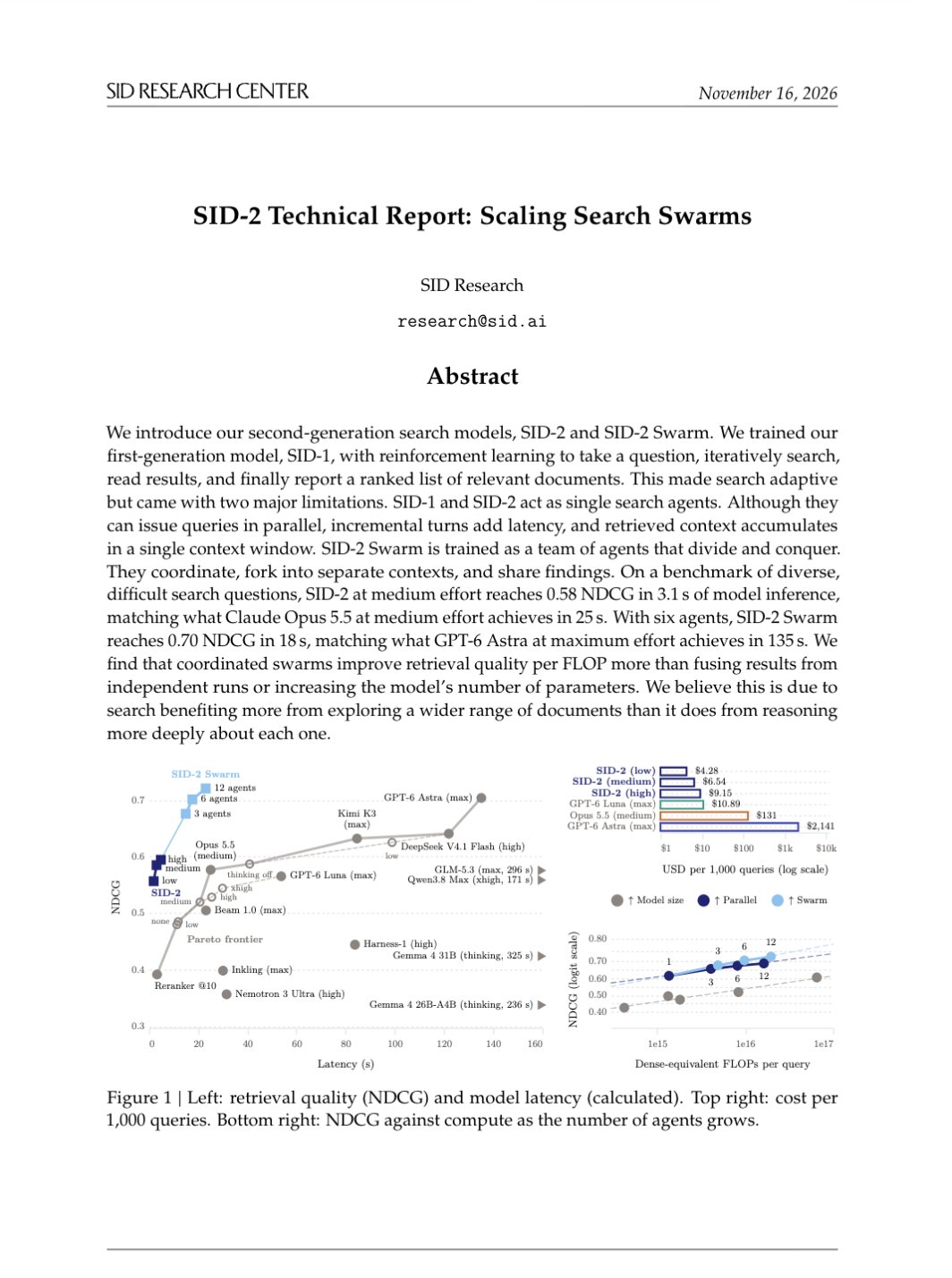
We have also released a full technical report chronicling the training techniques we used to make SID work.
We have also released a full technical report chronicling the training techniques we used to make SID work.
6:58 PM UTC · Nov 17, 2026 · 8.4K Views
5387110