

Priyanka Vergadia
@pvergadia
Forward Deployed Engineering FDE Interview prep in 4 weeks! x.com/i/article/2120…
The FDE Interview Loop, Explained
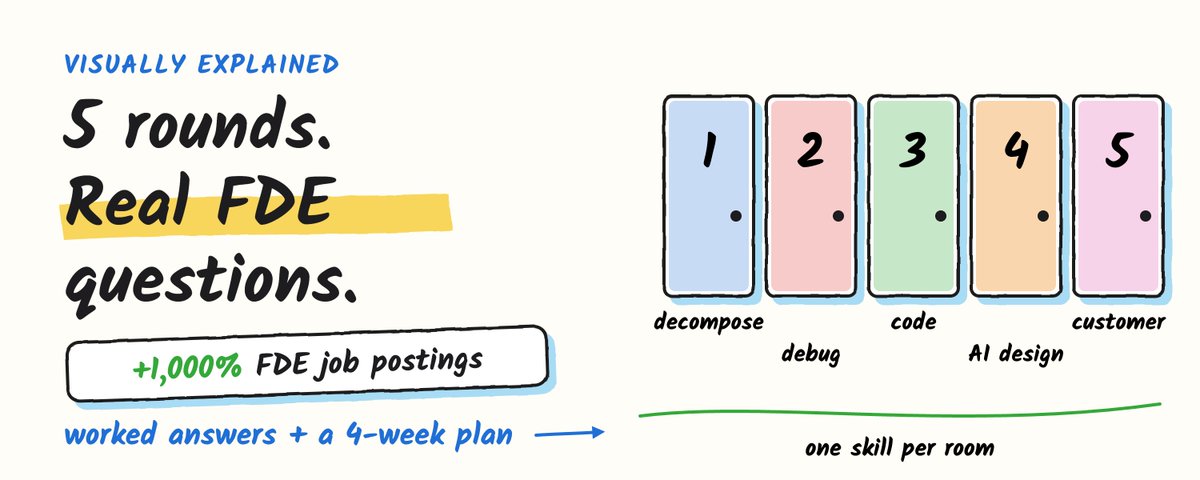
Five rounds, one skill: turning a messy customer problem into working software. Real prompts from Palantir, OpenAI and Google loops, worked answers with code, and a four-week prep plan.
Before we start, I am hosting FREE Live FDE Q&A session with Salesforce FDE team tomorrow Nov 25th, they are hiring: secure your spot here!
Top 1% FDEs need more than just good system design skills: I cover those this weekend in my upcoming workshop. Sign up to be in my very first cohort, last 5 seats left!
Forward deployed engineer job postings rose more than 1,000% between January and August 2026 compared with the same months a year earlier, according to Lightcast data reported by Fortune. Tech postings overall grew 13% over the same stretch, and the median advertised FDE salary sits above $188,000, against about $145,000 for a software engineer. Palantir invented the role in the early 2010s. Now OpenAI, Anthropic, Google, Microsoft and a long tail of AI startups hire for it, and their interviews feel odd to anyone trained on LeetCode. In one round there is no code at all, just a prompt like "design a system to improve traffic in NYC" and an hour.
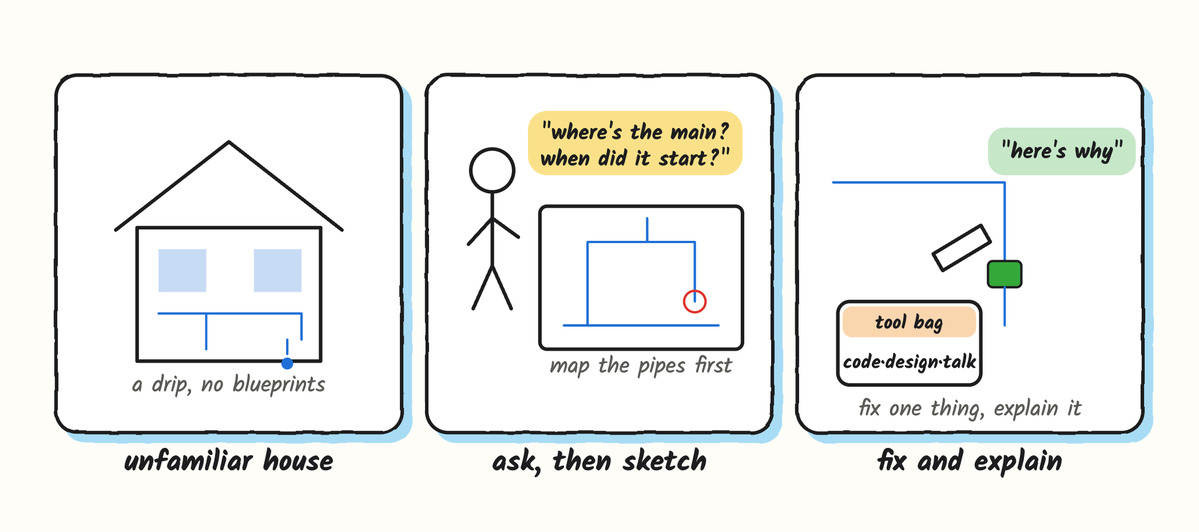
An FDE interview is a house call: an unfamiliar house, no blueprints, an hour to find the leak, and an owner who wants to know why.
I went through the published question banks and candidate reports for the Palantir, OpenAI, Anthropic and Google loops. The rounds have different names, but they test the same five skills: break down a vague problem, fix code you didn't write, ship small code that survives the real world, design an AI system you can prove works, and stay calm in front of a customer. Below I take one real prompt for each skill and work through the answer the way a strong candidate would, code included, then finish with a four-week prep plan.
The whole loop in 41 seconds: five interview rooms, one skill each, from a vague customer ask to a four-week prep plan.
What the loop actually looks like
Palantir's loop, per the Exponent guide built from candidate reports, is a 30-minute recruiter call, a coding screen (CodePair, Karat or HackerRank with SQL and an API task), then three 60-minute onsite rounds drawn from a pool of decomposition, learning, coding, re-engineering and system design, and a 60-minute hiring manager round that revisits your weakest area. Behavioural questions are folded into the technical rounds.
OpenAI's reported loop is longer: seven stages, including a take-home case study of about a week (one reported prompt: build semantic search over Amazon product data that ChatGPT can query), an AI-enabled coding screen, a project deep dive and a system design round full of customer scenarios. Anthropic doesn't publish its FDE loop; candidate reports describe a take-home and a customer-conversation simulation. And Gergely Orosz reported (as hearsay) that Google Cloud cut its FDE loop from 4–6 interviews over several weeks to as few as two over two days.
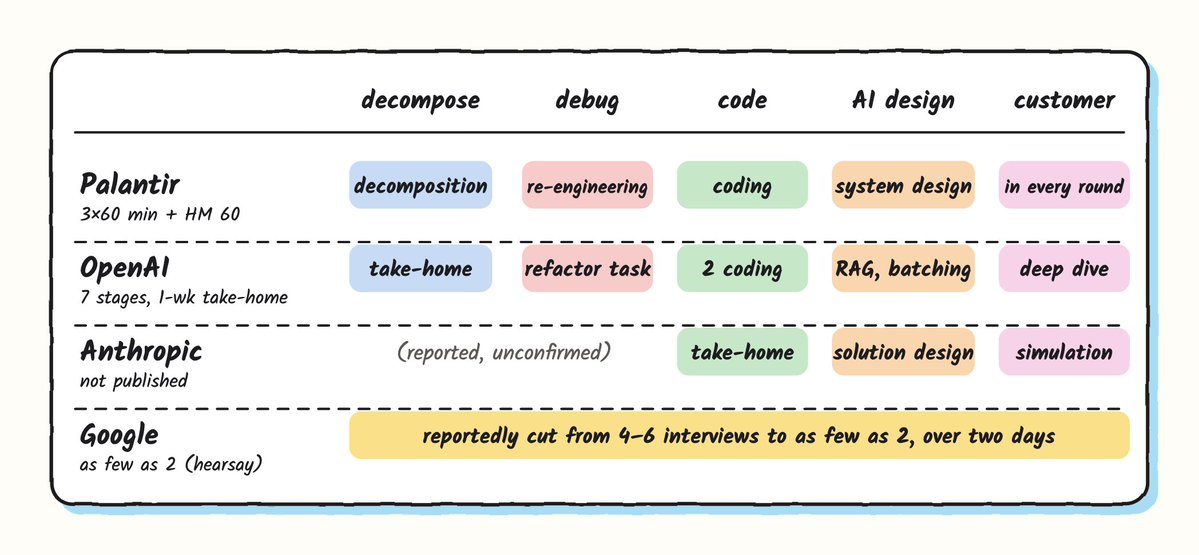
Different names, same five skills. Rows are reported loops (Palantir and OpenAI from Exponent's candidate-built guides; Anthropic and Google from thinner reports).
Round 1: decomposition (the one with no code)
This is the round Palantir made famous and most FDE teams copied. You get a sentence of a problem and 60 minutes. Nobody expects a finished design. The interviewer is watching whether you can turn fog into a plan a team could start on Monday. Customers rarely hand an FDE a clean spec, so this round is the job in miniature.
The approach most guides land on, and the one I'd use, has six moves. Say each one out loud so the interviewer can follow your thinking.
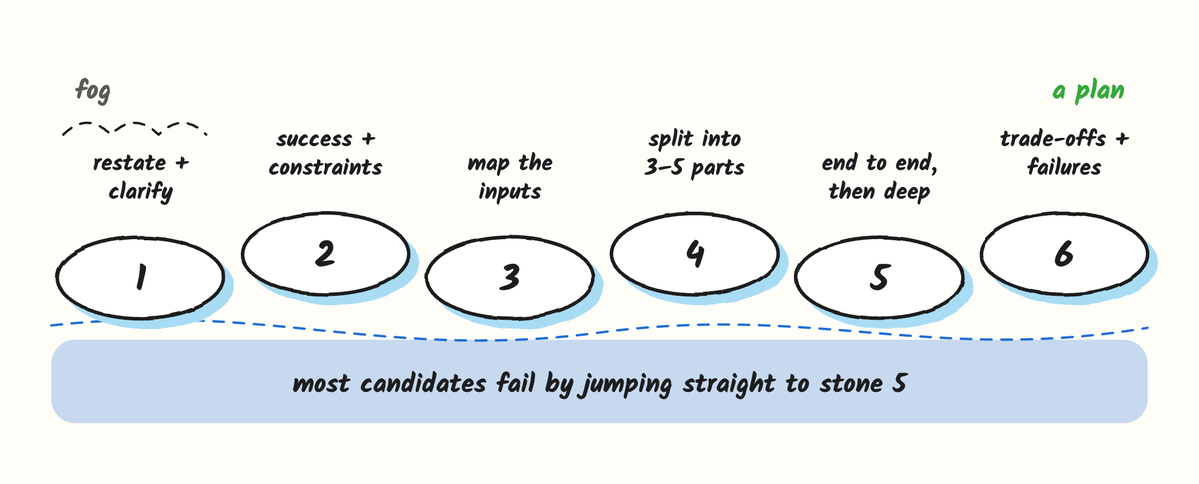
The six moves of a decomposition answer. The common failure is skipping the first three and designing a solution to a problem you guessed.
Worked example: "Design a sync system between two employee record systems"
This prompt appears in Palantir candidate reports. Here's how I'd run it.
Clarify. Which system is the source of truth, and is that true for every field? (Often HR owns job title and salary, IT owns email and laptop.) How many employees: 2,000 or 200,000? How fresh must data be? A new hire needs a badge on day one; a directory photo can wait a day. What does "delete" mean: a termination, or a typo fix? Who gets paged when sync breaks?
Success. Every active employee exists exactly once in both systems, owned fields match within 15 minutes (an assumption I'd state out loud), and no one is ever silently deleted.
Split it. Five parts with clear edges: identity matching, change capture, field mapping, conflict rules, and delivery with reconciliation.
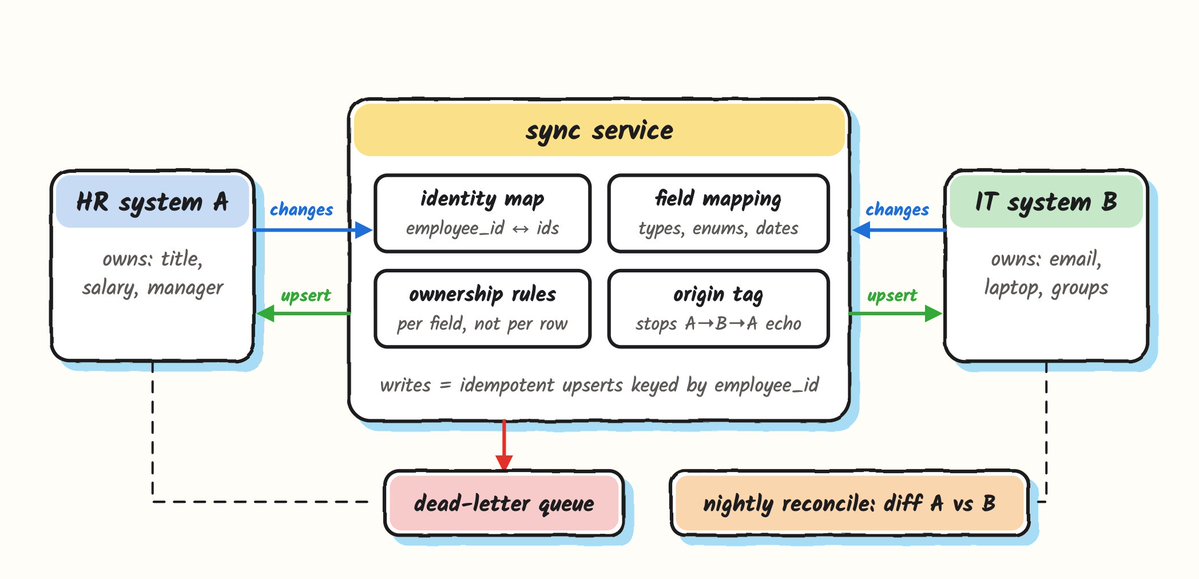
One way to decompose the sync prompt: changes in, a small service that knows identity and field ownership, idempotent writes out, and a nightly diff that catches what the fast path missed.
Go deep on the risky parts. Identity matching is where real deployments break. Match on a stable employee ID, never on name or email, because two people can share a name and emails change at marriage. Field-level ownership beats last-writer-wins: if HR owns title, an edit in IT gets overwritten and logged, not merged. And every write carries an origin tag, so when B's webhook fires for a change the sync service just made, it drops the echo instead of looping forever.
on_change(event): if event.origin == "sync": return # our own echo emp = identity.lookup(event.system, event.record_id) or quarantine(event) for field, value in map_fields(event): if owner(field) == event.system: target.upsert(emp.id, field, value, origin="sync") # idempotent
Trade-offs and failure modes. Webhooks are fast but drop events; polling with a cursor is slow but complete. Use both: webhooks for speed, the nightly reconcile for truth. Name what happens when B is down for six hours (queue, retry, alert at one hour) and when a bulk import of 10,000 records lands (rate-limit writes, batch them). Saying this before being asked is what separates a pass from a strong pass.
The decomposition round grades the questions you ask before you have an answer.
Round 2: re-engineering (debugging code you didn't write)
Palantir's re-engineering round hands you working-but-wrong code, a short module and then one several hundred lines long, and asks you to find the logic flaw. Reported prompts include a function that double-counts values in a HashMap and an infection-spread simulation on a social graph that returns the wrong count. OpenAI's version is a refactor: untangle deeply nested code without breaking the existing tests. On the job this is day one at every customer: their code, no docs, and something is off.
Here's a bug in the same family as the HashMap prompt, written for this post. The function should return units ordered per customer:
def units_per_customer(events): totals = {} for e in events: # e = {order_id, customer, qty, kind} totals[e["customer"]] = totals.get(e["customer"], 0) + e["qty"] return totals
It passes the happy-path test. Then you feed it real data. An amend event carries the order's new quantity, not the change, and the event bus redelivers some events after a timeout. Both get added again, so a customer who ordered 5 and then amended to 3 shows 8, or 11 once the amendment is redelivered.
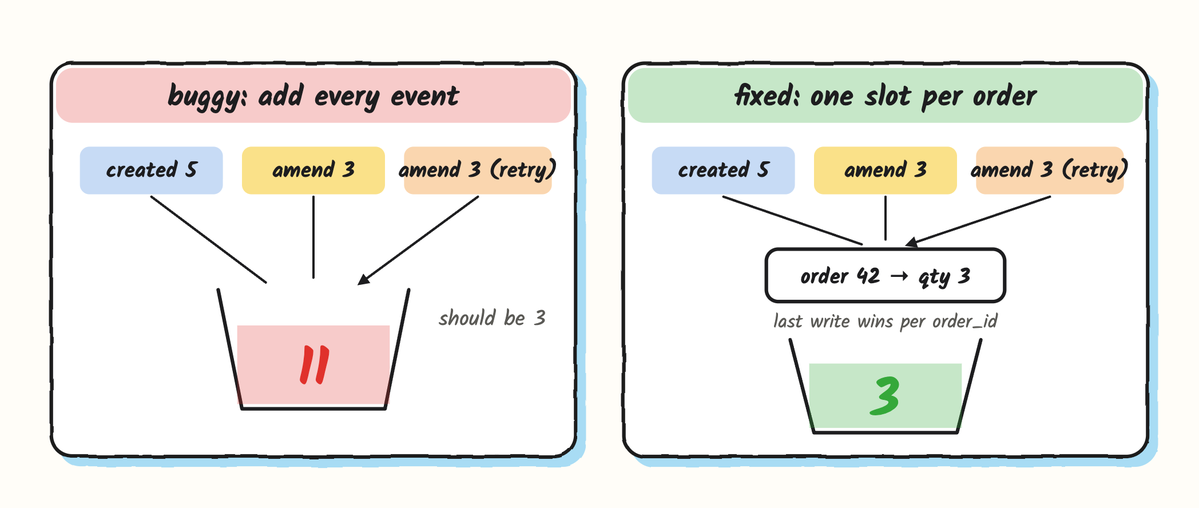
Created 5, amended to 3, amendment redelivered: the buggy tally says 11. Keying by order first and summing second gives 3.
The fix is to collapse events to one record per order, then sum:
def units_per_customer(events): latest = {} # order_id -> (customer, qty) for e in events: # assumes events arrive in order latest[e["order_id"]] = (e["customer"], e["qty"]) totals = {} for customer, qty in latest.values(): totals[customer] = totals.get(customer, 0) + qty return totals
The code isn't what they're grading here. They're grading how you got there. Before touching anything, write the smallest failing input (the three events above) as a test. State your hypothesis out loud ("amends are absolute, not deltas"), confirm it by reading where events are produced, then fix. Say the assumption the fix adds: events arrive in order. If they don't, keep a version number per order and keep the highest. Interviewers note candidates who start editing before they can reproduce the bug.
Round 3: practical coding
FDE coding rounds lean away from puzzles and toward the code you'd write at a customer site. Reported prompts: fetch paginated data from a REST API handling page size and total pages (Palantir screen); a credit system where credits expire on different rules (OpenAI); parse a messy CSV, build a rate limiter, retry with backoff (practitioner lists). Then they extend it: "now the API starts returning 429s."
A version that holds up in front of an interviewer:
import random, time, requests def fetch_all(url, page_size=100, max_retries=5): items, page = [], 1 while True: for attempt in range(max_retries): r = requests.get(url, params={"page": page, "per_page": page_size}, timeout=10) if r.status_code == 429 or r.status_code >= 500: wait = float(r.headers.get("Retry-After", min(30, 2 ** attempt))) time.sleep(wait * random.uniform(0.5, 1.0)) # backoff + jitter continue r.raise_for_status() # 4xx: our bug, fail loudly break else: raise RuntimeError(f"page {page} failed after {max_retries} tries") body = r.json() items.extend(body["data"]) if page >= body["total_pages"]: return items page += 1
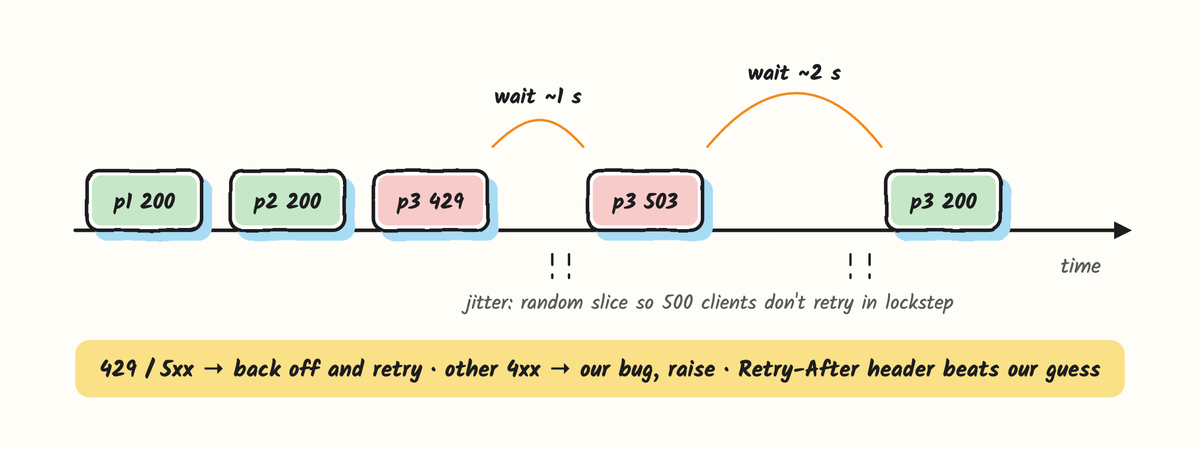
What the retry loop does on page 3: back off on throttling and server errors, randomise the wait, and stop at once on errors that retrying can't fix.
Then volunteer the follow-ups before they ask. Page-number pagination skips or repeats rows if the data changes mid-scan; a cursor (next_token) fixes that. Five pages at a time in parallel is faster but needs a shared rate limiter. A 10-million-row export shouldn't sit in a Python list; stream it to disk or a queue. Edge cases are worth a sentence each: an empty first page, total_pages missing, a page that returns fewer rows than per_page.
Round 4: AI system design
This is where AI-company loops differ most from Palantir's. Reported OpenAI prompts include "design the retrieval layer for a customer's private knowledge base and justify your chunking and indexing" and "what evaluation would you build to catch failures before a customer sees them?" Practitioner lists add the latency version: naive RAG takes 1.5 seconds, the customer wants under 100 ms.
The answer has two paths and a loop. Ingest: connectors pull documents, a parser keeps structure (headings, tables), chunks follow that structure rather than a fixed token count, and each chunk is stored with its embedding and its access-control list. Query: authenticate the user, retrieve with both keyword (BM25) and vector search, filter by what this user is allowed to read, rerank, then generate an answer with citations.
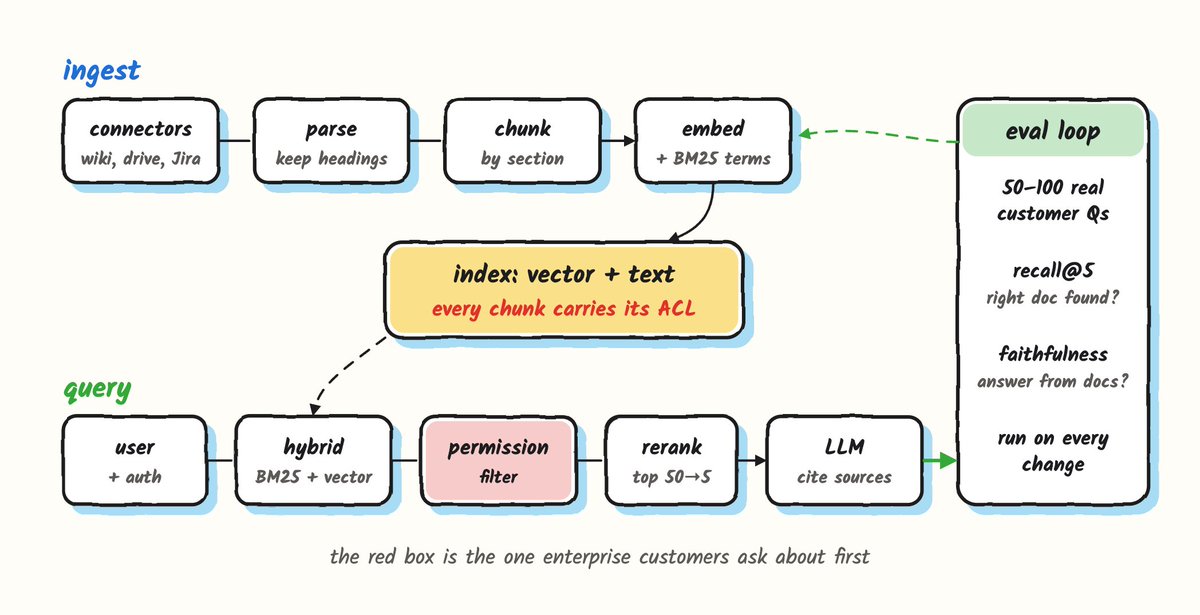
A private knowledge-base RAG design: structure-aware ingest, permissions stored with every chunk and enforced at query time, and an eval set built from the customer's own questions.
Three things earn points here. First, permissions. If a junior analyst can get an answer quoting the board deck, the project is over, so filter by ACL inside retrieval, not after generation. Second, evals the customer helped write: 50–100 real questions with the documents that answer them. Measure retrieval (did the right document land in the top 5?) separately from generation (does the answer stick to what was retrieved?), so when a score drops you know which half broke. Third, say when not to use RAG. Stable knowledge, like a style guide, can sit in the prompt. Behaviour, like output format, is a fine-tuning or prompting problem. Facts that change go to retrieval.
For the latency follow-up, show the budget before proposing fixes. The numbers below are an example breakdown I'd sketch on the whiteboard, not measurements:
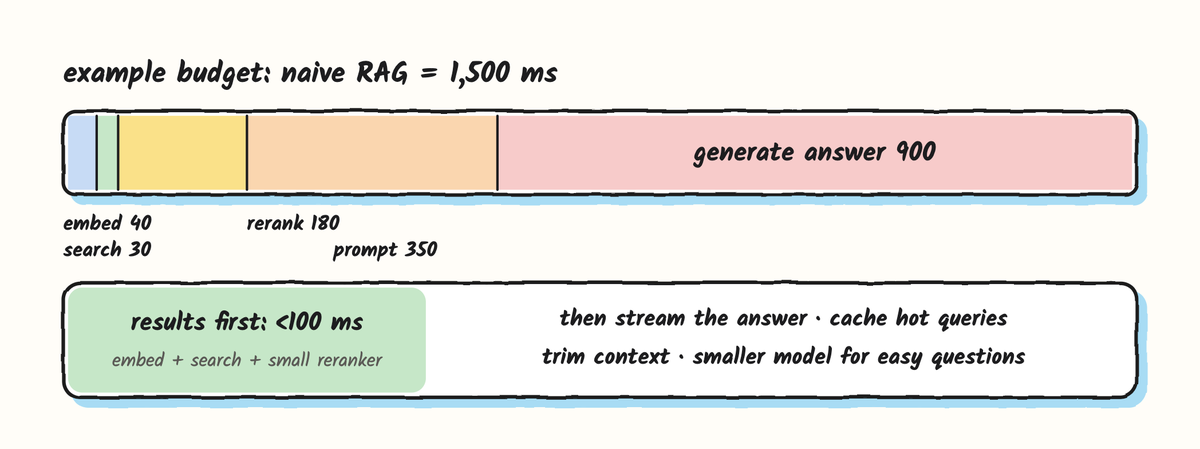
Find the time before you save it. In an example budget like this, generation dominates, so the honest answer to "under 100 ms" is ranked results first and the generated answer streamed after.
The honest answer to "under 100 ms" is that generation won't fit. Retrieval can. So return ranked results first and stream the answer after, cache frequent queries, cap the context, and route easy questions to a smaller model. Saying "that number is impossible as stated, here's what we can do" is the FDE skill they're looking for.
Round 5: the customer round
Every loop has one, whether it's called behavioural, hiring manager, deep dive or customer simulation. Reported prompts: "Tell me about a time you pushed back on a customer request" (Palantir), "explain a complex technical concept to a non-technical stakeholder" (OpenAI), and from practitioner lists, "the deployment slipped three weeks and the customer's CTO is on the call. What do you say?"
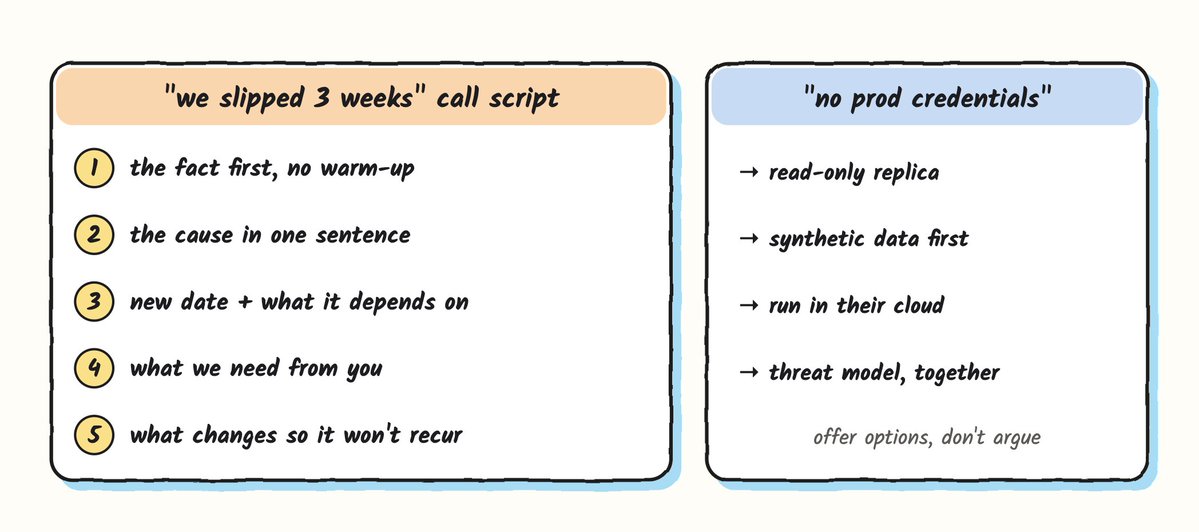
Two customer-round answers as cards: a five-line script for bad news, and four ways to get unblocked without asking security to bend its rules.
What they're scoring: do you lead with the bad news, own it without throwing your team under the bus, and leave the call with a decision? For the credentials question, the trap is arguing with security. Strong candidates offer paths that respect the rule: a read-only replica, synthetic data to build against, deploying inside the customer's own cloud account, and writing the threat model with their team.
Two more questions show up in nearly every loop. "Why FDE and not software engineering?" Have a specific answer about liking unclear problems and customer contact; Orosz estimates a Google FDE's week at roughly 25% coding, 50% integration and plumbing, and 25% meetings, so show you know that and want it. And the project deep dive: one system you built, defended decision by decision, including "were your evals measured or informal?"
The skills that separate the top 1%
Look at the loops again. Coding, debugging and system design are the bar to get in, and most people who reach the onsite clear it. The customer-facing rounds are different. Discovery, scoping, pushback, explaining and handling stakeholders show up in every loop, sometimes as a whole round and sometimes as a question tucked inside a technical one. In my experience these are the skills that decide offers, and later promotions. Strong coders are common in an FDE loop. Engineers who can walk into a room, find the real problem and bring a skeptical executive with them are not. That gap is what makes someone a top 1% FDE.
Here are the questions that test these skills, with what a good answer does and what a top 1% answer adds.
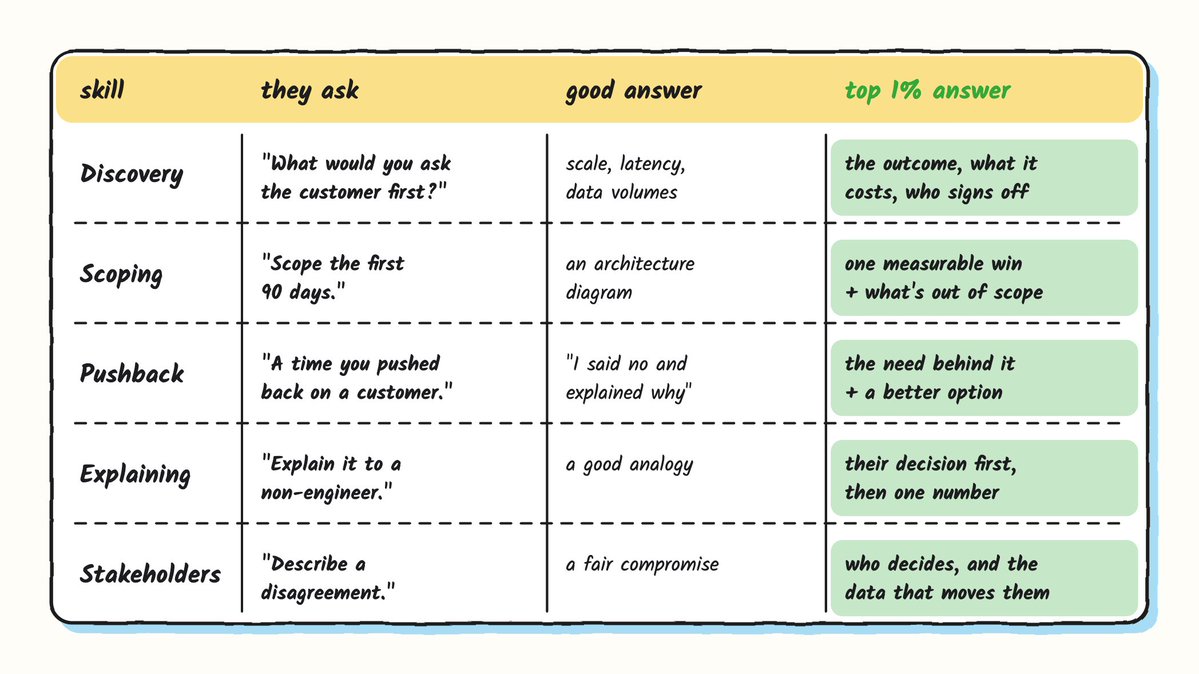
Five rounds that test the softer skills. A good answer gets you through. The top 1% answer starts from the customer's outcome and the people who decide.
"What questions would you ask the customer before designing anything?"
OpenAI asks this inside its system design round. A good answer asks about scale, latency and data. A top 1% answer asks about the business first: what happens today when this goes wrong, and what does it cost? Who signs off that the project worked? What has been tried before, and why did it stall? Then each technical question links back to those answers. "You said a missed fraud case costs about this much, so how much extra latency would you accept to catch more of them?"
"A bank wants one fraud view across three acquired systems. Scope the first 90 days."
This prompt comes from the prep guides, and it's really a scoping question dressed as design. A good answer draws the target architecture. A top 1% answer commits to one outcome you can measure by day 90, such as one fraud type in one business line. It also says plainly what is out of scope, names the person who makes decisions, and picks a first deliverable in week two that proves the project is worth funding. Executives fund a first step they can see working, not a full architecture diagram.
"Tell me about a time you pushed back on a customer request."
This is Palantir's hiring manager round. "I said no and explained why" is a pass. The stronger story names the need behind the request, explains in the customer's terms what doing it as asked would have cost them, offers an option that meets the real need, and says what happened next, including whether you were right. Interviewers listen for whether the customer trusted you more afterwards.
"Explain a complex technical concept to a non-technical stakeholder."
OpenAI's behavioural round asks this. Most candidates reach for an analogy, which is fine. Better: start from the decision the listener has to make ("you're choosing whether to launch in March"), then give one analogy and one number, and check they understood by asking what they'd do next. Explaining exists to help someone decide, so that's where the answer should start.
"Describe a disagreement with a customer or teammate."
Also from OpenAI's loop. A compromise is a safe answer. A top 1% answer shows you worked out who cared about what, found the person who could actually decide, and moved them with data rather than seniority. It also shows the relationship came out stronger.
The customer simulation
Candidate reports on Anthropic's loop describe a whole customer-conversation round, and prep guides describe interviewers playing a skeptical CIO, a stressed database administrator or a non-technical product manager. Run it like a real first meeting. Spend the first ten minutes on discovery before suggesting anything. Repeat the problem back in their words. Propose a small first step, name the risks yourself, and end by asking for a decision or a next meeting. Most candidates start pitching a solution within two minutes. Holding back until you understand the problem is what interviewers notice.
None of this is a personality trait. It's a method you can practise, the same way you practise system design. It's what I teach in my Top 1% FDE Masterclass.
A four-week prep plan
Each week trains one skill, and they build on each other. About an hour a day on weekdays and a longer session at the weekend is enough.
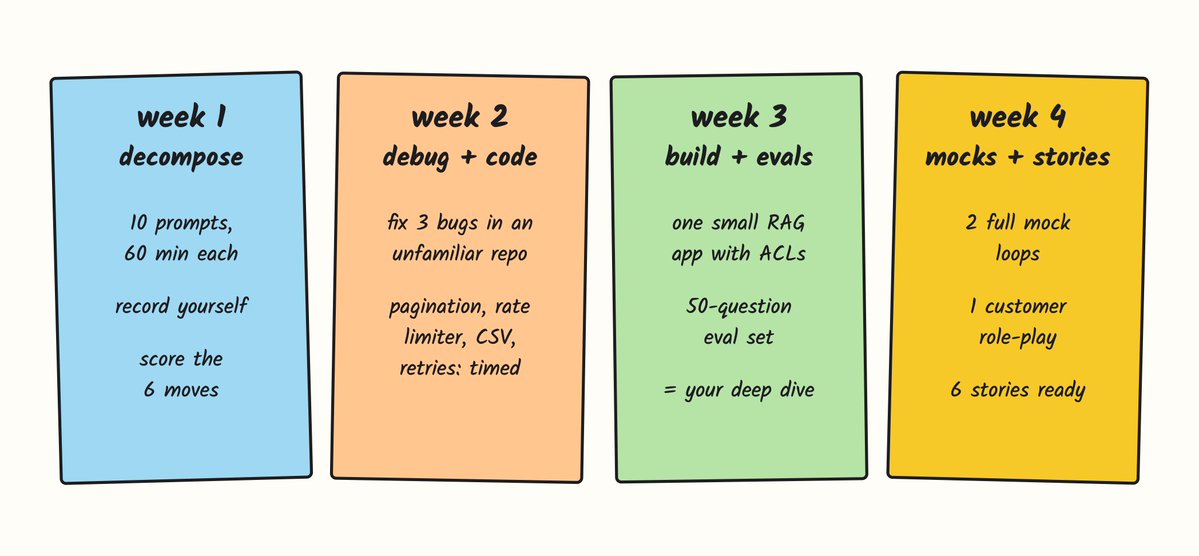
Four weeks, one skill each. The app you build in week 3 becomes the project you defend in the deep dive.
For week 1, use prompts from this post and make your own from the news: a hospital wants to cut emergency room wait times, an insurer wants claim summaries across millions of historical claims, a bank wants one fraud view across three acquired systems. Set a timer, talk out loud, record it, and play it back once. You'll hear yourself skip the clarifying questions, and you only need to hear it once.
For week 4, write six stories in a few lines each: a time you pushed back on a customer, a deadline you missed and what you said, explaining something technical to an executive, a project you owned end to end, a disagreement with a teammate, and a decision that turned out wrong. Most behavioural questions map to one of these six.
What to take away
- Same five skills. Palantir, OpenAI, Anthropic and Google name their rounds differently, but all of them test decompose, debug, code, AI design and customer handling.
- Questions first. In decomposition, the first ten minutes of clarifying questions are worth more than any diagram that follows.
- Reproduce, then fix. In debugging, a failing test before any edit is the signal they look for.
- Prove it works. In AI design, permissions in retrieval and an eval set from the customer's real questions beat a fancier model.
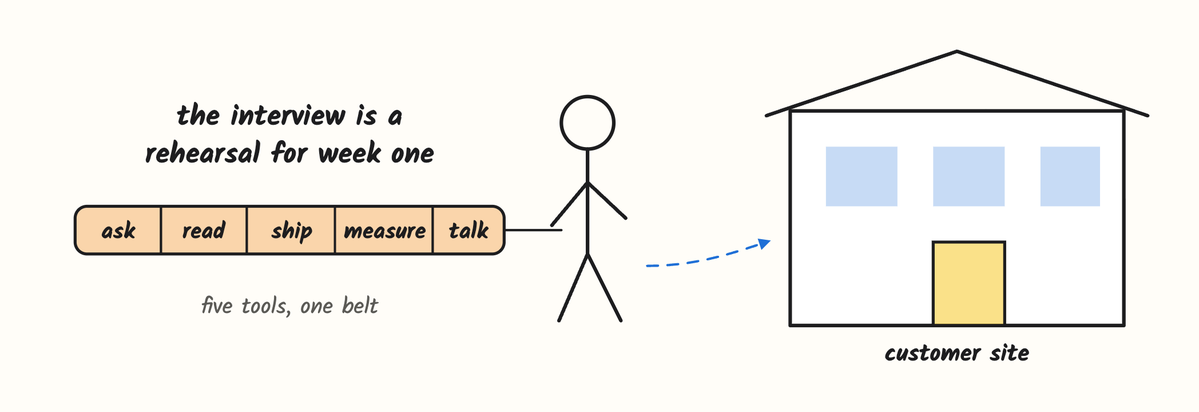
The skills the loop tests are the same ones you'll use in the first week on a customer site, so practise them as work, not as trivia.
My view: the FDE loop is one of the fairer interviews in tech, because it tests what the job actually is. LeetCode practice won't get you far here. Real reps will: break a fuzzy problem down out loud, fix someone else's code, build one small AI system and measure it, and practise delivering bad news. Do those for four weeks and you'll be ready for the interview and for the job.
Sources: Fortune, "Forward-deployed engineers…" (Sep 3, 2026), Lightcast posting and salary data; Exponent/Aced, Palantir and OpenAI FDE interview guides and decomposition guide (candidate-reported prompts and loop structure); Gergely Orosz, The Pragmatic Engineer, "Forward deployed engineering heats up again" (May 24, 2026), Google loop change (reported as hearsay) and time split; AI Engineering Insider, "Cracking the Forward Deployed AI Engineer Interview" (Jul 21, 2026), AI-depth and delivery prompts; Vinoo Ganesh, Latent Space, "The Rise of the Forward Deployed Engineer". Interview loops change often and companies don't publish most of them; treat stage counts as reported, not official. The code examples and the latency budget were written for this post. thecloudgirl.dev
Enjoyed this? Follow me on Substack for more visually explained articles: priyankavergadia.substack.com
9:38 PM UTC · Nov 24, 2026 · 31.8K Views
12706111.1K